

Diversion
Definition
Youth diversion is a set of informal, non-statutory practices which enable children to avoid formal criminal justice system processing – a statutory out of court resolution or a court prosecution – and the attendant negative consequences such as a criminal record, labelling, and interruption of education, training or employment. To access diversion, children usually receive a short assessment before being referred into light-touch supportive interventions. These schemes operate for under-18s in a variety of different models across the country. In formal policing outcome terms, the alternative outcomes resulting from these schemes could include community resolutions and no further action.
The Youth Justice Board defines diversion as: “where children with a linked offence receive an alternative outcome that does not result in a criminal record, avoids escalation into the formal youth justice system and associated stigmatisation. This may involve the YJS delivering support / intervention that may or may not be voluntary and/or signposting children (and parent/carers) into relevant services. All support should be proportionate, aimed at addressing unmet needs and supporting prosocial life choices.”
Although formal out-of-court resolutions (that is, youth cautions and youth conditional cautions), can be considered diversionary as they divert the child away from court, our focus here is informal diversion as described above. The diversion options are:
When dealing with offences committed by children the police have a range of outcomes available that avoid criminalising them, as per sections 135- 138 of the Legal Aid, Sentencing and Punishment of Offenders (LASPO) Act 2012. Although there may be variation in local terms used by YJSs and police to describe these, available outcomes include:
- Community Resolution (Out of Court Resolution): A diversionary police outcome that can only be used when children have accepted responsibility for an offence. It is an outcome commonly delivered, but not limited to, using restorative approaches.
- No Further Action: An outcome used when the police decide not to pursue an offence for various reasons. This may be because there is not enough evidence, or it is not in the public interest. Voluntary support may be offered to children to address identified needs.
- No Further Action – Outcome 22: A diversionary police outcome that can be used when diversionary, educational or intervention activity has taken place or been offered, and it is not in the public interest to take any further action. An admission of guilt or acceptance of responsibility is not required for this outcome to be used.
- No Further Action – Outcome 21: A diversionary police outcome used when further investigation, that could provide sufficient evidence for charge, is not in the public interest. This includes dealing with sexting offences without criminalising children.
- No further action - Outcome 20: A police outcome where the case is diverted, often to another agency (e.g., social services, school) for support, rather than being handled formally.
You can also find a diversion process map in our youth diversion toolkit.
Research summary
The backfire effect of formal processing
Many years of large-scale criminological research have determined that there are clear patterns of offending tied to levels of maturity.1 This body of research has observed that, across a wide range of jurisdictions, offending behaviour (both detected and self-reported) peaks in the mid-teens before dropping steeply at the onset of young adulthood, then declining more slowly. This phenomenon is known in the research literature as the age-crime curve. While a small number of children’s offending will continue long into their adulthood, the vast majority are essentially law-abiding children who are temporarily drawn into adolescent delinquency and who quickly grow out of this phase as developmental maturity proceeds and self-control improves.
In other words, children tend to grow out of crime. However, evidence shows that formal criminal justice system processing can arrest this process, leading to more crime. An international meta-analysis, based on a major systematic review of 29 outcomes studies involving more than 7,300 children over 35 years represents the most comprehensive analysis to date of the impact of formal justice system processing. This study concluded that formal processing ‘appears to not have a crime control effect, and across all measures, appears to increase delinquency. This was true across measures of prevalence, incidence, severity, and self-report.’ It highlighted that, ‘rather than providing a public safety benefit, processing a juvenile through the system appears to have a negative or backfire effect.’2
Turning to the British evidence base, The Edinburgh Study of Youth Transitions and Crime, an ongoing research programme involving more than 4,000 children in Scotland, found that children brought to a court hearing are nearly twice as likely to admit engaging in serious offending in the following year as children (with matched backgrounds and comparable prior self-reported offending behaviour) who did not face a court hearing.3 This is complemented by a research study of youth offending in Northamptonshire which found that prosecution increased the likelihood of reoffending, even when controlling for personal and offence characteristics.4
The evidence for youth diversion
The evidence consistently shows that when similar groups of children, comparable in demographics, offences and offending histories, are matched, and one group is formally processed while the other is diverted, the diversion groups do better. Systematic reviews have found that children who were processed had higher reoffending rates than those who were diverted, even after controlling for differences between these populations.5 Petrosino et al (2019), for example, found that diversion schemes reduced the prevalence, severity, and frequency of both official offending and self-reported reoffending.6
This reduction in reoffending is seen in the UK evidence base too. The Edinburgh Study of Youth Transitions and Crime states that the best approach to reducing reoffending by children is a policy of ‘maximum diversion’ – an approach featuring the minimum possible formal intervention coupled with diversion to programming outside the justice system.7 Indeed, one of the ‘key facts’ about youth crime this landmark study demonstrates is that ‘diversionary strategies facilitate the desistance process’.8
Youth diversion works because it avoids children feeling labelled as ‘criminals’ by the justice system and because it seeks to minimise and, in many cases, eliminates children’s contact with negative peer pressure. If not avoided, these contacts may imprint impressionable children with new negative attitudes and behaviours, and may increase the risk of continued offending.10 Additionally, youth diversion avoids the collateral consequences of formal processing, such as interference with education, training and employment (including school exclusion, and future labour market consequences of carrying a criminal record). These collateral consequences can impede rehabilitation well beyond the end of the direct punishment imposed. Finally, by facilitating access to interventions and support services designed to address the underlying reasons behind children’s offending, diversion can tackle reoffending.
Top tips for delivering child-centred diversion
- Recognise your role within the system: Police are working within a system that can often focus on punitive approaches. Though necessary at times, it is not suitable to address all types of offending, especially with children. Less contact with the formal system can lead to better outcomes for children. Police forces reduce contact through targeted prevention, diversion, interventions, and signposting referrals to relevant agencies and support in the community.
- Avoid ridged eligibility criteria: Police should move away from inflexible eligibility criteria based solely on Child Gravity matrix scores, offence type and number of prior offences. The child and the offence should be assessed based on the context behind the offence, the child's needs, and the risk of harm and safety.
- Improve partnership working: It is important to note that diversion might not always be the best option for the child, or they might already have services that they are engaging with who are better suited to offer support. Police should involve partners at the earliest opportunity to ensure the right agencies is engaging with the child at the right time
- Understand the context behind the offence: In partnership with other agencies such as Youth Justice Services and Children's Social Care, officers should make all efforts to identify the needs and vulnerabilities of the child through information sharing, quality assessments and including the voice of the child and their families. This will enable better inventions for the child and an opportunity to address the cause of the offending at the earliest opportunity.
- Maximise joint decision making: Police should steer away from deciding outcomes for children prior to the child's case being reviewed at a joint decision-making panel. These panels provide agencies with the opportunity to discuss the child, their background and their strengths while highlighting the gravity and frequency of their offending, and possible harm to victims/the community. Panels should be used to get the whole picture of the child and decide (jointly) what outcome and intervention is best suited.
- Challenge language and behaviour: Diversion can only be successful in an environment that promotes and supports children being seen as children. Police should encourage child first language, guard against adultification and ensure there is regular training of staff including on being trauma responsive. Staff should feel empowered to challenge language or behaviour that is not child centred during feedback and regular reviews of the diversion process.
In addition to these tips, our core principles of youth diversion can help embed a child-centred approach. These are:
- Minimise labelling: Youth diversion should take all reasonable steps to avoid stigmatising the young people they work with, and to prevent them from forming deviant or delinquent identities that may interfere with their development.
- Avoid net-widening: Ensure that the scheme operates as an alternative to the formal justice system, rather than as a supplement to it. Diversion should only be for young people who would otherwise be dealt with formally in the criminal justice system.
- Do not overdose young people: Programming offered through diversion should be therapeutic and targeted. For most diverted young people, this will generally be light touch and informal.
- Guard against disparities: Access to, and engagement with, youth diversion schemes should be facilitated in a way that ensures all those suitable can avail themselves of its benefits. Diversion should help address disparities, rather than exacerbate them.
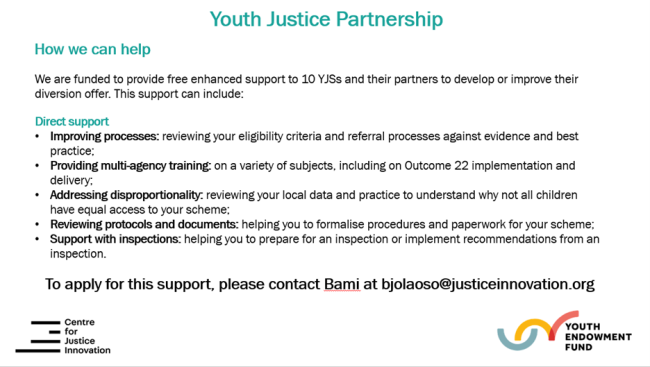
Our practice support offer
Youth diversion is a set of informal, non-statutory practices which enable children to avoid formal criminal justice system processing – a statutory out of court resolution or a court prosecution – and the attendant negative consequences such as a criminal record, labelling, and interruption of education, training or employment. To access diversion, children usually receive a short assessment before being referred into light-touch supportive interventions. These schemes operate for under-18s in a variety of different models across the country. In formal policing outcome terms, the alternative outcomes resulting from these schemes could include community resolutions and no further action.
The Youth Justice Board defines diversion as: “where children with a linked offence receive an alternative outcome that does not result in a criminal record, avoids escalation into the formal youth justice system and associated stigmatisation. This may involve the YJS delivering support / intervention that may or may not be voluntary and/or signposting children (and parent/carers) into relevant services. All support should be proportionate, aimed at addressing unmet needs and supporting prosocial life choices.”
Although formal out-of-court resolutions (that is, youth cautions and youth conditional cautions), can be considered diversionary as they divert the child away from court, our focus here is informal diversion as described above. The options and process are as follows:
Centre for Justice Innovation publications
Practice development publications
Guidance on how to deliver diversion effectively for children and young people- this guidance published in 2025 supports police forces to embed robust and transparent decision-making, effective partnership working and evidence-based support.
Inspection Frameworks: Youth diversion and out of court disposals- this 2024 briefing examines the frameworks in place to monitor diversion delivery by YJSs and the police.
Valuing youth diversion: A toolkit for practitioners- this is our flagship youth diversion publication, with the sixth edition published in 2024. It is designed to help practitioners implement and improve diversion schemes in their area.
This short video explainer, created in 2022 by Reality Art with children in mind, details what diversion is, the benefits it offers and what the process involves.
Research publications
How is youth diversion working for children with special educational needs and disabilities?- This 2024 research report explores, and seeks to improve, how diversion is working for children with SEND. The accompanying literature review is Exploring the Responsiveness of Youth Diversion to Children with SEND.
Children and young people’s voices on youth diversion and disparity- This 2022 research report builds on the previous report, below, crucially centring the experiences of children and young people.
Equal diversion? Racial disproportionality in youth diversion- This 2021 research report explores the unequal playing field that exists for children in terms of access to, and engagement with, youth diversion. The accompanying literature review is Disparities in youth diversion – an evidence review.
Mapping youth diversion in England and Wales- In 2019, we systematically mapped youth diversion across England and Wales to provide a clearer picture of the realities of, and gaps in, its provision.
Evidence and practice briefings on: minimising labelling, eligibility criteria, effective referral, and understanding youth diversion in London.
Policy publications
Data on youth diversion- this briefing, published in 2024 and commissioned by the Youth Endowment Fund, provides an overview of youth diversion data; who collects this data and what it includes, an assessment of the current data available and recommendations for improvement.
Six steps forward for diversion in the youth justice system- this 2022 briefing reflects on the incremental but important changes in the youth justice system since we published our 2020 briefing ‘Strengthening youth diversion’.
Mainstreaming youth diversion- this 2021 briefing summarises discussions from a meeting of leading figures from the justice system on how to put youth diversion on a more mainstream footing.
Useful reading
As well as the Centre’s diversion publications, see also, for example:
The effectiveness of diverting children from the criminal justice system: meeting needs, ensuring safety, and preventing reoffending- This inspection by HM Inspectorate of Probation and HM Inspectorate of Constabulary and Fire & Rescue Services was published in October 2025. It points to a fragmented and inconsistent system and calls for stronger governance, clearer guidance, and more consistent practice in the use of out of court resolutions for children.
YJB Case Management Guidance- this guidance on the use of out of court resolutions covers diversion, including a section on why you need to focus on diversion.
Informal approaches to Pre-court diversion- this toolkit technical report by the National Children’s Bureau reviews the evidence on the effectiveness of informal pre-court diversion programmes as a strategy to prevent violence, crime and offending among children and young people. It was published in September 2025.
Diversions from the criminal justice system in London- This analysis by the Behavioural Insights Team was published in June 2025 and draws on a substantial Met Police dataset. Key findings include that diversion is associated with reduced reoffending and that black children and young people are diverted less often, even when controlling for the seriousness of offences.
Diversion Practice Guidance- this Youth Endowment Fund guidance- co-authored by us at the Centre for Justice Innovation and published in April 2025 – sets out seven recommendations to effectively implement diversion practices for children.
Understanding referral pathways and diversionary support for children within the criminal justice system in England and Wales- this research by Cordis Bright highlights the highly variable decision-making around diversion, with differences in local eligibility criteria, use of informal resolutions, and the availability of evidence-based support services. It was published in April 2025.
Exploring racial disparity in diversion from the Youth Justice System- This Nuffield-funded study by academics at the University of Bedfordshire and Manchester Metropolitan University, published in April 2025) found that racial disparity increases as the severity of diversionary outcomes rises.
Prevention and Diversion Project Final Report- this two-year review of youth justice services’ prevention and diversion work (published in 2023) was conducted by the YJB in collaboration with the Probation Service and Association of YOT Managers.
Video resources
This short video details what diversion is, the benefits it offers and what the process involves. It has been created with children in mind and was created by Reality Art.
YJB Prevention and Diversion Assessment Tool Q&A
YEF- Virtual Learning Cafe: Doing Diversion Effectively
Centre for Justice Innovation- How is youth diversion working for children with SEND?
Centre for Justice Innovation- What is diversion?
Child First Diversion Pathfinder Bradford- learning event
Good practice examples
Diversion in Gloucestershire
Diversion has been operating in Gloucestershire since 2018 and is referred to as Children First. This includes Community Resolutions, and Outcome 22 (Deferred Cautions and Deferred charge).
This is a partnership between:
•Police
•Youth Justice Service
•CAMHS
•Children's Social Care
•Restorative Gloucestershire
The team in diversion follows clear written guidance that is constantly updated and reflects both changes in practice and legislation, and there is a strong professional working relationship between decision makers.
Efforts are made to ensure:
- The YJS will bring children back to the panel where there are concerns about engagement/compliance
- The reoffending of children diverted in measured and reported to the partnership on a quarterly basis
- There is consideration of the victims' views both at the decision and review stage.
Between Jan and Dec 2024;
- 93 children were diverted, meaning these children had support but without the associated criminogenic stigma of a formal outcome.
- Around 70% of children are receiving outcomes in under 3 months; this also means victims get a timely response.
- Between April 2022 and March 2023, 103 children were diverted using Outcome 22.
- 13 children reoffended (inc. subsequent diversion), a binary rate of 12.6%.
- The 13 children committed a total of 24 reoffences, an average of 2.67 per child
- 87.4% of children diverted did not reoffend within 12 months.
Key takeaways:
- Clear and shared objectives with regularly updated guidance owned by the partnership
- With deferred outcomes, use the review process and be transparent where there are challenges around engagement / participation
- Monitor the reoffending and include subsequent diversions in this measure
Continue to evolve and innovate to achieve the best outcomes for children and victims
Templates
Leicestershire YJS Child Self Assessment- Leicestershire YJS have designed a self-assessment tool to accompany the YJB’s prevention and diversion assessment tool. This self-assessment tool is not mandatory (the YJB’s tool should itself be completed with the child and family) and services considering using one are advised to co-produce their own version with the children they supervise.
At the Centre for Justice Innovation, we have a wealth of resources and templates for youth diversion, please contact us for access.
References
- Bottoms, A. (2006). Crime Prevention for Youth at Risk: Some Theoretical Considerations. Resource Material Series No. 68, 21-34; Hirschi, T., Gottfredson, M. (1983). Age and the Explanation of Crime. The American Journal of Sociology, 89 (4), 552-584; Moffitt, T. (1993). Adolescent-Limited and Life-Course-Persistent Antisocial Behavior: A Developmental Taxonomy, Psychological Review, 100 (4), 674-701.
- Petrosino, A., Turpin-Petrosino, C., Guckenberg, S. (2010). Formal System Processing of Juveniles: Effects on Delinquency. Campbell Systematic Reviews.
- McAra, L., McVie, S. (2007). ‘Youth Justice? The Impact of System Contact on Patterns of Desistance from Offending’. European Journal of Criminology 4 (3) 315-34.
- Kemp, V., Sorsby, A., Liddle, M., Merrington, S. (2002). Assessing responses to youth offending in Northamptonshire. Nacro Research briefing 2.
- See, for example: Petrosino A, Turpin-Petrosino C, Guckenberg S (2010). Formal System Processing of Juveniles: Effects on Delinquency. Campbell Systematic Reviews; Wilson, D., Brennan, I., Olaghere, A. (2018). Police-initiated diversion for youth to prevent future delinquent behavior. Campbell Systematic Reviews.
- Petrosino, A., Petrosino, C., Guckenburg, S., Terrell, J., Fronius, T. A., & Choo, K. (2019). The effects of juvenile system processing on subsequent delinquency outcomes. In D. P. Farrington, L. Kazemian, & A. R., Piquero (Eds.), The Oxford Handbook of Developmental and Life-course Criminology (pp. 553 – 575). New York: Oxford University Press.
- McAra, L., McVie, S. (2010). Youth Crime and Justice: Key Messages from the Edinburgh Study of Youth Transitions and Crime. Criminology and Criminal Justice 10 (2) 179-209
- McAra, L., McVie, S. (2013). Delivering Justice for Children and Young People: Key Messages from the Edinburgh Study of Youth Transitions and Crime.Justice for Young People: Papers by Winners of the Research Medal 2013, 3-14.
- See, for example, Schur, E. (1973). Radical non-intervention: Rethinking the delinquency problem. Englewood Cliffs, NJ: Prentice-Hall.
- Wilson, H., Hoge, R. (2013). The Effect of Youth Diversion Programs on Recidivism: A Meta-Analytic Review. Criminal Justice and Behavior, 40 (5), 497-518.
Get in touch
We plan to keep this toolkit up to date. Please get in touch if you have any resources to add or want to give us feedback by emailing info@justiceinnovation.org.