

Earlier this month, experts by experience, practitioners, policymakers, researchers and sector leaders from across the UK gathered in Birmingham for our national conference on Effective Community Justice for Women.
Supported by our partners at The JABBS Foundation for Women and Girls, the conference brought together people working across courts, policing, probation, health, the civil service, women’s centres and the voluntary sector to explore what effective, gender-responsive community justice looks like in practice.
At a time of growing focus on reducing women’s imprisonment and strengthening community-based responses, the conference created space not just to reflect on the challenges facing the sector, but to focus on what is already working, where innovation is emerging, and how partnerships can support long-term change.
Opening the conference, our Interim Director, Vicki Mulligan, reminded attendees that behind every policy discussion are women’s lives and experiences.
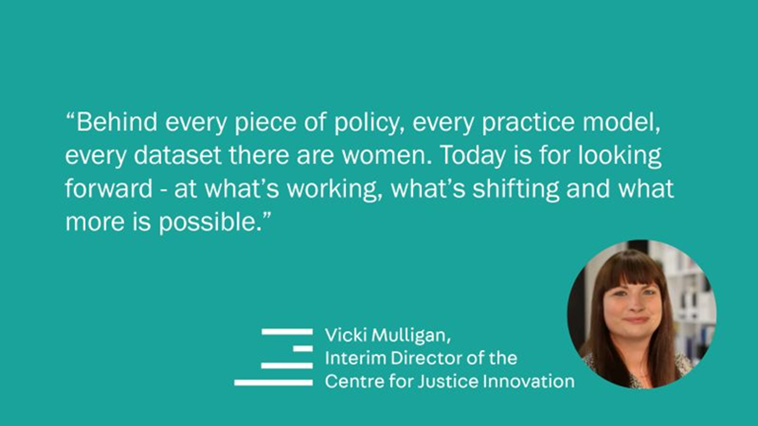
That forward-looking approach shaped the day. Across workshops, panel discussions and lived experience storytelling, speakers returned to the importance of building systems that respond to women’s realities, strengths and needs, looking to the existing excellent practices already in place as a foundation to build from.
Building shared understanding across the sector
The conference was built around three core aims: deepening shared understanding of specialist, gender-responsive approaches for women; improving awareness of current practice and emerging evidence; and strengthening cross-sector relationships.
Those themes ran throughout the day. Conversations across workshops and panel discussions focused on the importance of trust, collaboration and stronger connections between services. Speakers reflected on the need for a whole-system approach where policing, courts, probation, health services, women’s centres and community organisations work together rather than in isolation.
There was also a clear sense that effective community justice for women depends on prevention, early intervention and long-term support rather than crisis responses alone.
What effective community justice looks like in practice
Following reflections from Lord Timpson, Minister for Prisons, Parole and Probation, recognising the vital work taking place across the women’s justice sector and setting out his perspective on the direction ahead, there was a choice of 12 practice and learning workshops. Sessions explored a range of topics across women’s community justice, sharing emerging evidence and examples of best practice such as diversion and early intervention, trauma-informed practice, women’s problem-solving courts, racial disproportionality, specialist domestic abuse responses, pregnancy and early motherhood, and community-based alternatives to custody. We heard from practitioners, academics and policymakers across a range of areas of women’s community justice, including from Swansea’s Specialist Domestic Abuse Court, Tomorrow’s Women Glasgow and Brimingham Women’s Intensive Supervision Court.
Speakers highlighted how many women in contact with the justice system are also living with trauma, abuse, poverty, substance use and caring responsibilities. Across the workshops, there was a consistent message that community solutions work best when they are trauma-informed, recovery-focused, designed around women’s lived realities and backed by evidence and evaluation.
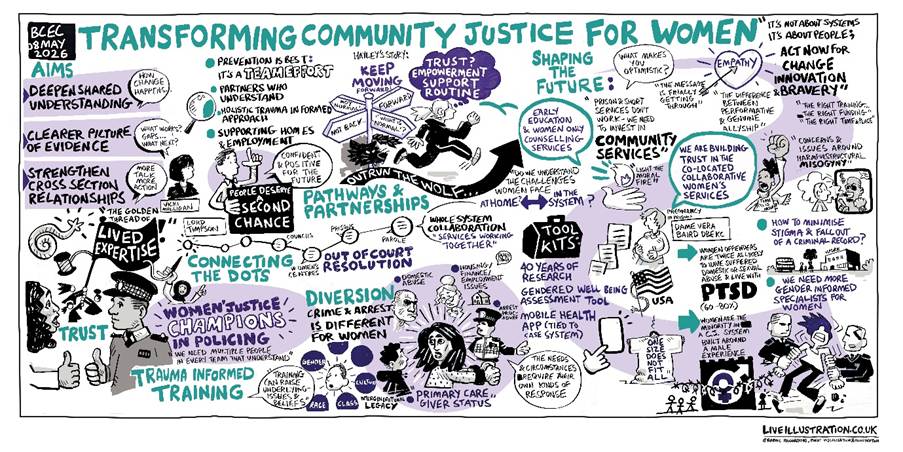
Rather than presenting a single model or solution, the conference highlighted the breadth of work already happening across the sector and the shared commitment behind it. The live illustration captured many of the themes emerging from the day: trust, empathy, lived expertise, pathways and partnerships, diversion, and community-led support.
Centring lived experience
One of the most powerful elements of the conference came from Made by Mortals, who led an immersive storytelling session centred on women’s lived experience.
Using audio co-produced with women with lived experience of substance use and the justice system, including insights from women from Lancashire Women, participants listened through headphones to the story of “Hayley”, a woman navigating recovery, trauma, motherhood and contact with services.
The session placed people directly into Hayley’s world, bringing listeners into her thoughts, fears, frustrations and hopes as she tried to move forward while facing multiple barriers. Discussions afterwards focused on what support would genuinely help someone in Hayley’s position and what obstacles women continue to face when navigating services and the criminal justice system. Women from Lancashire Women who contributed to the project were in attendance and shared their own reflections on what effective support looks like in practice.
The session reinforced a theme that surfaced throughout the conference: the importance of embedding lived and living experience into both policy and practice. Speakers repeatedly reflected on the need to build responses with women, not simply for women.
The lived experience of women in the justice system was also embedded through artwork produced by women in prisons and on probation involved in Koestler Arts displayed digitally across the conference space, and through Deeds Not Words’ stall, selling items created with women in contact with the justice system to raise funds for their work.
Shaping the future of women’s justice
The afternoon keynote from Dame Vera Baird DBE KC focused on the future of women’s justice reform and the role that community-based responses can play in reducing women’s imprisonment.
Reflecting on the work of the Women’s Justice Board, Dame Vera spoke about the need to design justice responses around women’s experiences and needs, rather than adapting systems primarily built around male patterns of offending and sentencing. She highlighted the work of Birmingham’s Intensive Supervision Court and the wider potential of problem-solving and community-based approaches.
The expert panel, hosted by Dame Vera Baird, brought together Dame Nicole Jacobs, Domestic Abuse Commissioner for England and Wales, Rokaiya Khan, CEO of Together Women, Kate Morrissey, Regional Head of Health and Justice for East of England at NHS England, Stephanie Akhter, Director of the Women’s Justice Commission US and Sal Naseem, former Director of London Independent Office for Police Conduct & CJI Trustee, for an honest discussion about the future of women’s justice.
Panellists reflected on funding pressures, structural misogyny and gaps in support, while also pointing to opportunities for progress through stronger partnership working, investment in women’s services and learning from emerging approaches in the UK and internationally.
Lived experience, collaboration and community support remained central themes throughout the discussion. Panellists spoke about the need for services that understand women’s experiences and recognise that effective responses cannot come from one agency alone.
Building momentum for change
Closing the conference, Karyn McCluskey, CEO of Community Justice Scotland and Chair of Trustees at the Centre for Justice Innovation, reminded attendees that the people in the room are at the heart of change.
Alongside the formal sessions, the conference created space for practitioners, researchers, policymakers, women’s organisations and women with their own experiences of the system to connect with one another, share learning and reflect on both the opportunities and challenges facing the sector.
While many discussions acknowledged the scale of the issues women continue to face, the conference offered hope. It showcased the depth of expertise, commitment and innovation already present across the sector and the growing evidence supporting community-based approaches for women. It was a privilege to spend the day with so many practitioners, researchers and stakeholders dedicated to achieving better outcomes for women, a reminder that progress depends on sustained collaboration, shared learning and continued investment in approaches that are shaped around women’s experiences.
We are grateful to everyone who joined us in Birmingham, including all speakers, workshop facilitators, partners and attendees who contributed to such thoughtful discussions throughout the day, and especially The JABBS Foundation for Women and Girls for their generous support.
We are pleased to be continuing the conversations from the conference through a new online event series focused on each of the 12 workshop themes. The first two sessions are now open for registration: Racial disproportionality in women's diversion work & London’s Whole-System Approach and Domestic Abuse Counter Allegations.